A box-to-box midfielder is a central midfielder who contributes in both defence and attack: recovering the ball, moving it forward and supporting chances near the opposing penalty area. The role is usually associated with the No. 8, but it describes a player’s duties, not a required shirt number.
What does box-to-box mean in soccer?
The two boxes are the penalty areas at either end of the pitch. A box-to-box player connects those ends through successive phases of play. That does not mean sprinting into both boxes on every possession: sometimes the best decision is to stay behind the ball and cover a teammate.
Stamina alone does not define the role. A player needs to make useful contributions while defending, progressing possession and supporting attacks. Running forward without checking the space left behind can expose the team.
What position and number is a box-to-box midfielder?
The usual starting position is central midfield. In a 4-3-3, a box-to-box No. 8 can play ahead of and to one side of a holding No. 6. In a midfield pair, the two players must coordinate who advances and who protects the centre.
No. 8 is a role label, not a shirt-number rule. A player wearing 14 or 22 can perform it. Our soccer position numbers guide explains how tactical numbers differ from squad numbers.
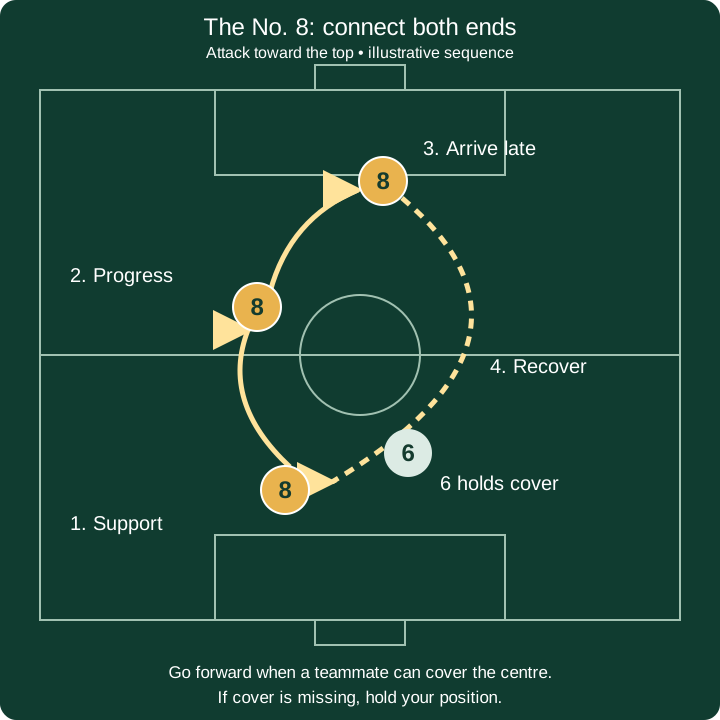
Original schematic: the three No. 8 markers show one player at successive moments, not three players. The route changes with the ball, opponents and available cover.
The four main duties
1. Defend and cover central space
Track runners, support challenges and protect passing lanes when a teammate presses. Recovery should bring the player into a useful defensive position; simply chasing the ball may open another gap.
2. Progress the ball
Scan before receiving. If a forward lane is open, pass through it or carry the ball into space. When opponents close the route, combine with a nearby teammate instead of forcing a dribble.
3. Support attacks with late runs
A delayed run can add a target after defenders have committed to the striker and wingers. The useful destination might be a cut-back lane, the edge of the box or space between a full-back and centre-back. Entering the box is an option, not an obligation.
4. React when possession changes
After a turnover, decide whether the team can immediately pressure the ball together or needs to recover its shape. If the ball cannot be pressured effectively, protect the centre and track the next threat.
Box-to-box vs No. 6, CDM, No. 8 and No. 10
| Role | Starting area | Main emphasis | What distinguishes it? |
|---|---|---|---|
| No. 6 / holding midfielder / CDM | In front of the defence | Screen central space and support build-up | Usually preserves cover beneath the attack |
| Box-to-box midfielder | Central midfield | Defend, progress and support attacks | Repeated contributions across phases |
| No. 8 | Central midfield or an inside channel | Connect midfield and attack | A broad label: some 8s control possession rather than make end-to-end runs |
| No. 10 / attacking midfielder | Behind the forwards | Receive between lines and create chances | Usually begins higher and focuses more on the final third |
CDM means central defensive midfielder. A player can switch between CDM and box-to-box duties across matches, but the tasks are not interchangeable. If both midfielders run beyond the ball, nobody may be left to screen the defence.
For detailed comparisons, see No. 6 vs No. 8 and No. 8 vs No. 10.
Famous player examples: what to watch
Players’ roles vary by season and coach. Use these examples to recognise actions rather than assign a permanent label to an entire career.
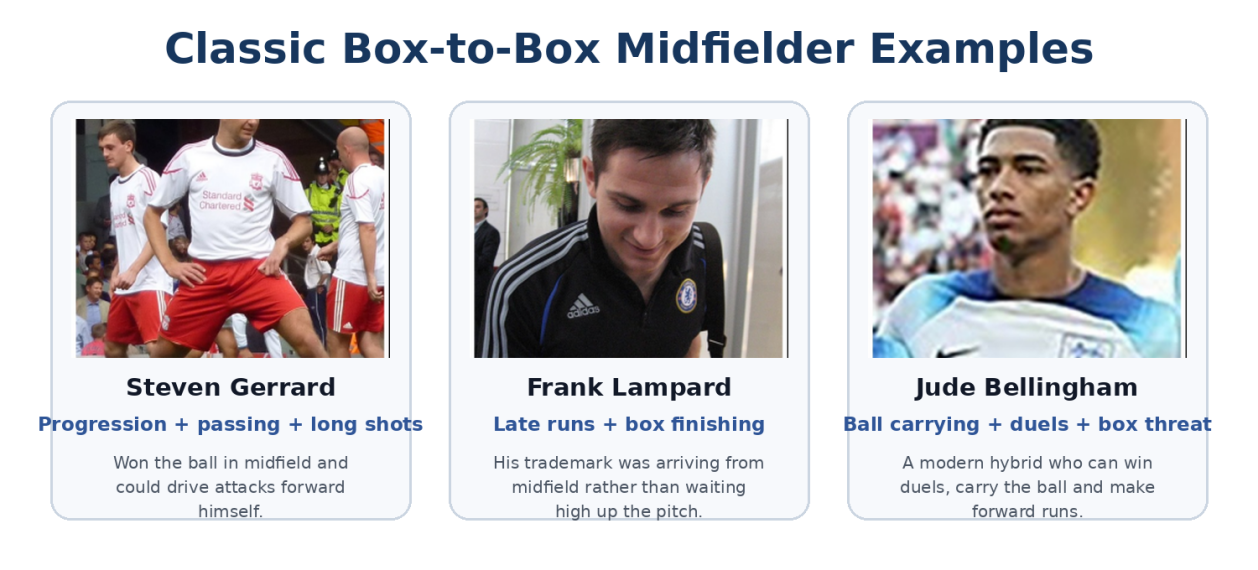
Three different emphases within an all-round midfield role: Gerrard driving play forward, Lampard arriving to finish, and Bellingham combining carrying with duels and attacking support.
Steven Gerrard: turn a regain into an attack
Gerrard illustrates the player who can influence both ends of a move: compete for possession in midfield, then help the team advance through a carry or a forward pass. His passing range and shooting threat gave opponents more than one problem to solve. Liverpool’s Gerrard profile describes him as an archetypal box-to-box midfielder.
What to watch: his next action after possession changes. Does he have space to carry, a teammate making a forward run, or a reason to keep the ball? The lesson is to recognise the opportunity quickly, not to attempt a long shot after every regain. Gerrard also played other roles, including a deeper position later in his Liverpool career.
Frank Lampard: arrive in the box instead of waiting there
Lampard shows why a midfielder’s timing can matter as much as speed. Starting behind the forwards lets a player arrive after defenders have turned their attention toward the ball. Chelsea’s retrospective on Lampard highlights both his scoring and his wider contribution to midfield play.
What to watch: his position before the final pass, not just the finish. A useful training cue is to stay available behind the attack, then enter a free lane when the passer can find you and a teammate is covering midfield. Lampard illustrates the attacking end of the role; copying his runs does not remove your defensive duties.
Jude Bellingham: carry, compete and support the attack
Bellingham’s Dortmund period offers a modern example of combining midfield duels, forward carrying and attacking support. The Bundesliga’s review of his development at Dortmund discusses that box-to-box contribution. His role has varied with team structure, so an advanced performance should not automatically be treated as a model for every No. 8.
What to watch: the transition from receiving under pressure to travelling with the ball, followed by the decision to pass, support or recover. The transferable skill is connecting actions: winning a duel is only the beginning if the next touch gives possession away.
You do not need to imitate one player completely. Use Gerrard to study progression, Lampard to study arrival timing, and Bellingham to study how carrying and physical contests connect with the next phase. Then apply those lessons within your team’s instructions.
How to play the role: a decision sequence
This is an illustrative training scenario, not an account of a particular professional match.
- Before receiving: look over both shoulders. Locate the nearest opponent, your holding midfielder and a forward option.
- As the ball arrives: receive with a body shape that lets you see the next pass. If the forward route is blocked, use support.
- After passing wide: check who is covering central midfield. With cover in place, offer a late supporting run; without it, remain available behind the attack.
- When the move ends: react to the ball and the next opponent. Recover into the team’s shape rather than jogging back along the same route automatically.
A useful review question is: did my run help the attack without leaving an avoidable gap? This is more informative than judging the role only by distance covered.
Required skills and training ideas
| Skill | Practice idea | What to observe |
|---|---|---|
| Scanning and first touch | Receive from a partner, identify a free passing gate, then play through it | Did you look before the ball arrived? |
| Passing and carrying | Play a small-sided game with end zones | Did you choose a carry only when space was available? |
| Timing forward runs | Build an attack through a wide player, with one midfielder arriving and another holding | Was central cover in place before the run? |
| Defensive awareness | On a turnover, have the group reset or press together according to the coach’s instruction | Did you protect the most dangerous route? |
| Repeat effort | Use short game-based bouts with rest appropriate to the players | Can you still make sound decisions as fatigue builds? |
These are practice ideas, not a fixed conditioning prescription. Adjust space, numbers and duration to the player’s age and level with a coach. For youth players, rotate roles so they learn both the attacking and covering responsibilities.
Which formations suit a box-to-box midfielder?
4-3-3: support ahead of a holding player
A No. 6 can provide cover while an 8 supports play higher up. The two 8s still need to coordinate their movement; the holding player cannot cover every open channel alone.
4-4-2: coordinate a midfield pair
When one central midfielder advances, the other usually needs to provide balance. Against three central opponents, the pair may need help from a forward or wide midfielder before one can leave the centre.
4-2-3-1: selective runs from a double pivot
One of the two deeper midfielders can join attacks while the other holds. The No. 10 already occupies advanced central space, so the arriving player should find a complementary lane rather than crowd the same pocket.
Common questions
Is every No. 8 a box-to-box midfielder?
No. Number 8 describes a central-midfield role more broadly. A possession-focused 8 may emphasise passing angles and control rather than repeated runs between the two penalty areas.
Does a box-to-box midfielder have to score goals?
Goals can be a useful contribution, but the role also includes progression, recovery and cover. Judge the player against the team’s instructions, not a single scoring target.
Can a box-to-box midfielder play defensively?
Yes. Defensive contribution is part of the job. The difference from a dedicated holding player is the expectation to support attacking phases as well, when the team has enough cover.
What is the biggest mistake in this role?
Treating every attack as a signal to run forward. Check the ball, teammates and opponents first: sometimes staying in midfield is the action that keeps the whole move balanced.